We are excited to share that two new Data for the Common Good projects have been selected for funding through the University of Chicago Provost’s Global Faculty Awards.
The Provost’s Global Faculty Awards support international faculty activities that build meaningful research collaborations between UChicago faculty and partners around the world. For D4CG, these awards will support two projects focused on responsible data sharing, data harmonization, and global collaboration in biomedical research: a Latin American Data Sharing and Harmonization Workshop and the launch of the Pan-Asian Health Data and AI Collaborative.
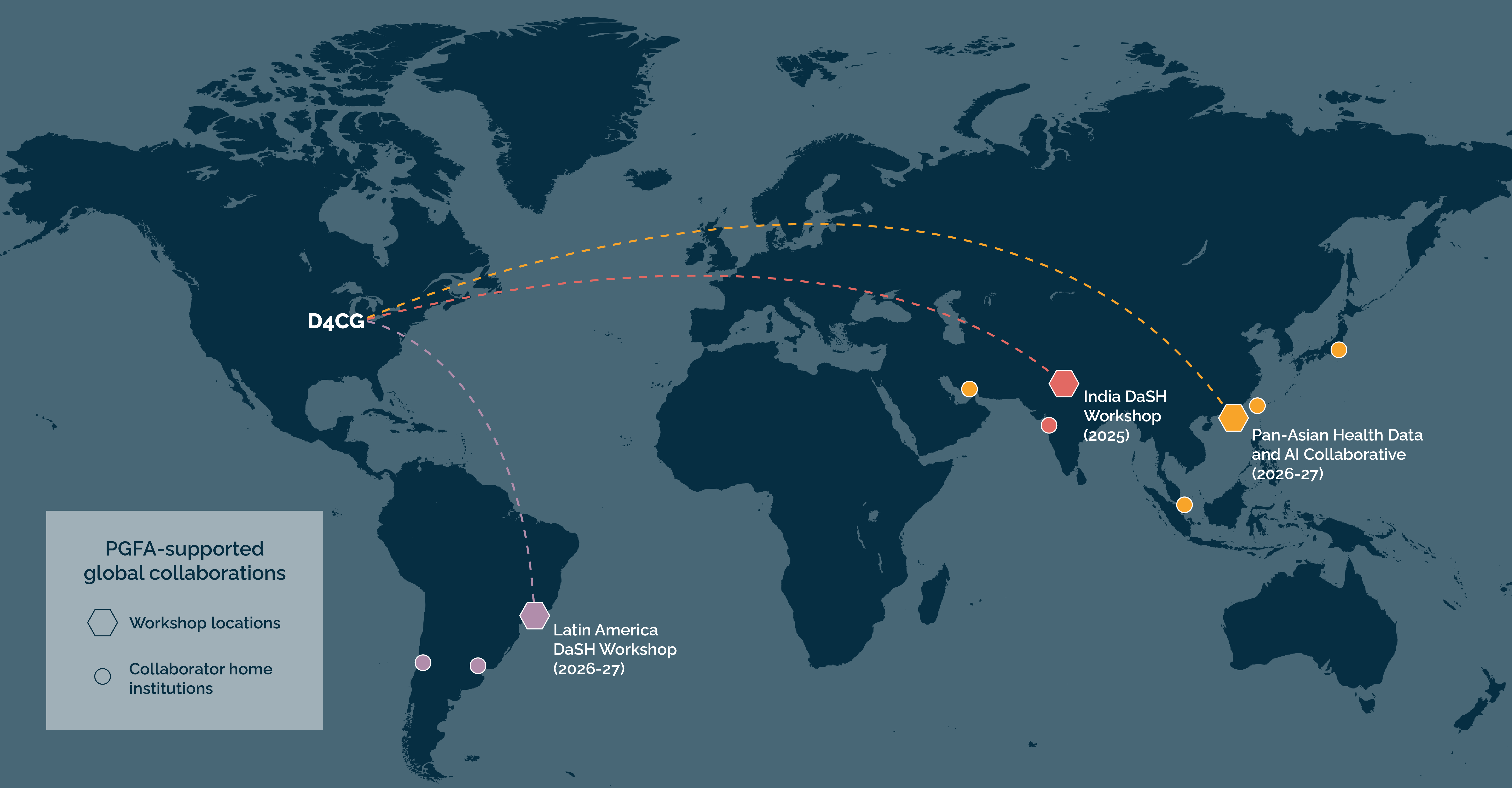
Together, these awards mark the second and third D4CG-affiliated projects to receive support through the PGFA program. In FY2025, the program helped fund our first Data Sharing and Harmonization (DaSH) Workshop in India, which brought together clinicians and researchers from across India to discuss data standards, governance, and pathways for increased participation in the Pediatric Cancer Data Commons (PCDC).
Building on the DaSH model in Latin America

The Latin American Data Sharing and Harmonization Workshop will build on the model of the India DaSH Workshop, bringing together members of our PCDC team and Latin American pediatric oncology collaborators for a two-day workshop in São Paulo, Brazil.
While the PCDC has enabled data sharing across numerous countries, many regions remain underrepresented in international pediatric cancer research, including parts of Latin America. Led jointly with Dr. Milena Villarroel (University of Chile) and Dr. Gabriela Villanueva (Hospital de Clínicas José de San Martín, Buenos Aires), the DaSH workshop will be a co-developed, bidirectional exchange. Workshop sessions will focus on the landscape of pediatric oncology data sharing in Latin America, the PCDC’s infrastructure and governance model, and practical pathways for researchers and institutions to participate in the data commons. Participants will share perspectives from their own institutions and discuss potential data contributions, research questions, and priorities for future collaboration.
Following the workshop, the PCDC team will continue to work virtually with collaborators to support participation in PCDC-affiliated disease consortia, advisory groups, data contribution processes, and research project requests using PCDC data. The goal is not only to expand Latin American representation in the data commons, but also to support reciprocal, long-term collaboration with Latin American investigators as co-leaders in data governance, consortium decision-making, and future research.
Launching the Pan-Asian Health Data and AI Collaborative
Despite the wealth of biomedical data generated across East and Southeast Asia, these regions have historically been underrepresented in global research due to technical barriers, differing national data governance structures, language challenges, and limited cross-border infrastructure. Our second PGFA-supported project, co-led by D4CG’s Dr. Junhan Zhao and our UChicago collaborator Dr. Siwei Chen (Department of Human Genetics), will launch the Pan-Asian Health Data and AI Collaborative, an initiative focused on responsible, scalable, and privacy-preserving biomedical research across East and Southeast Asia.
Anchored at the University of Chicago Francis and Rose Yuen Campus in Hong Kong, with the Institute of Digital Medicine at City University of Hong Kong as a core partner, this initiative will bring together biobanks, academic medical centers, and biomedical researchers from Hong Kong, Taiwan, Japan, Singapore, and the United Arab Emirates. The collaborative will focus on shared challenges in cross-border biomedical research, including secure data sharing, data harmonization, federated learning, AI development and validation, regulatory considerations, and ethical AI governance.
The project will begin by bringing together experts from the collaborative with an in-person symposium at the Yuen Campus. UChicago participants will share their relevant expertise and regional partners will present current projects, challenges, and collaborative interests, with the goal of developing a shared framework for data harmonization, data security, and long-term collaboration.
After the launch symposium, the group will continue meeting virtually throughout the year. These meetings will advance two multi-institutional pilot research projects: a multimodal AI study in pediatric oncology led by Dr. Zhao with partners in Hong Kong, Japan, Singapore, and Taiwan and a population-based genomic study of ultra-rare epilepsy variants led by Dr. Chen with collaborators in Japan, Singapore, and Taiwan. The initiative will also establish working groups and committees focused on publications, strategy, data sharing ethics, and sustainable growth. A virtual summit at the end of the first year will bring the full group together to share progress, refine the collaborative framework, and plan next steps.
Continuing our commitment to global data collaboration
Across both projects, this support from the Provost’s Global Faculty Awards will help D4CG and our collaborators deepen relationships, build shared infrastructure, and create more inclusive pathways for participation in international biomedical research. We are grateful to the University of Chicago Provost’s Global Faculty Awards program for supporting this work, and to our collaborators in Latin America, Asia, and across the University of Chicago community. We look forward to sharing more as these projects develop.